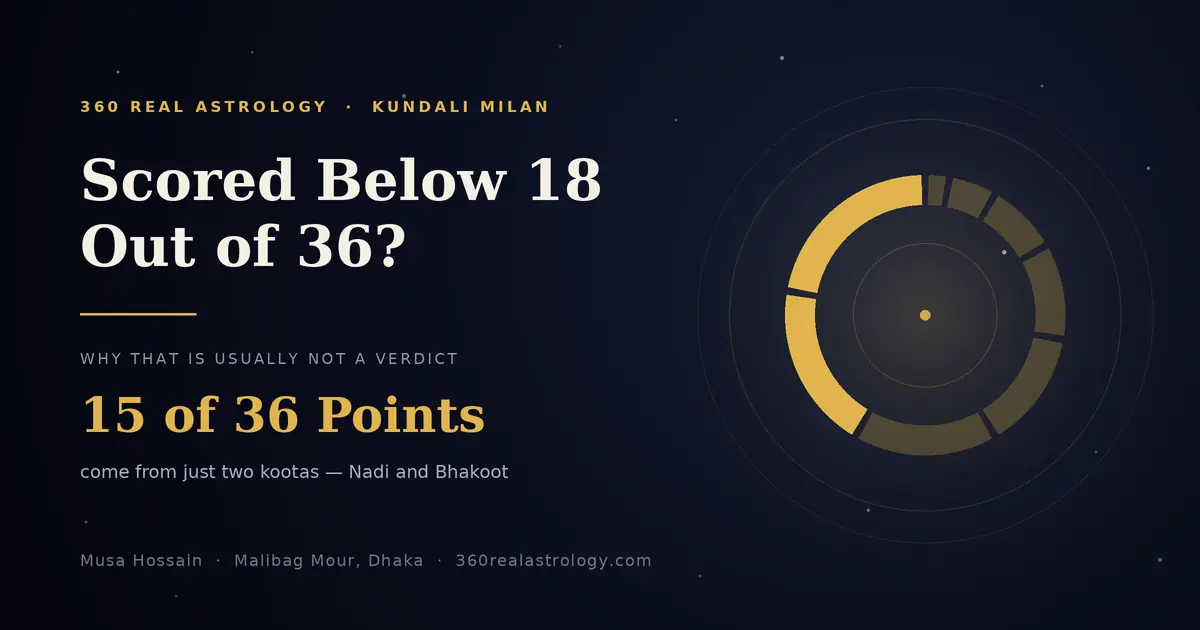
Usually, yes. A guna milan score below 18 out of 36 is a signal to look more closely, not a verdict on the marriage. Two of the eight kootas — Nadi and Bhakoot — carry 15 points between them, so a couple can lose nearly half the total from two factors alone, both of which have well-established cancellation rules. More importantly, the whole 36-point system reads only the Moon’s nakshatra in each chart. It does not look at the seventh house, its lord, Venus, Jupiter, Mars, or either person’s dasha periods. A score is a first filter, not an assessment.
I say this having watched families call off engagements over a number, and having also seen a family push ahead on a score of 32 into a marriage that was miserable within three years. The number is far less predictive than its reputation suggests.
What the 36 points actually measure
| Koota | Points | What it looks at |
|---|---|---|
| Varna | 1 | Broad temperament grouping |
| Vashya | 2 | Mutual influence and attraction |
| Tara | 3 | Birth-star compatibility, health and fortune |
| Yoni | 4 | Physical and instinctive compatibility |
| Graha Maitri | 5 | Friendship between the Moon-sign lords |
| Gana | 6 | Temperament: deva, manushya, rakshasa |
| Bhakoot | 7 | Moon-sign relationship, prosperity and wellbeing |
| Nadi | 8 | Constitutional type, traditionally linked to progeny |
Eighteen out of 36 is the conventional threshold. Above 24 is considered good, above 32 excellent.
Look at the distribution and the problem becomes obvious. Nadi and Bhakoot together are 15 points. Fail both and you start at 21 before anything else is even considered. Fail both and drop a couple of the smaller kootas, and you are under 18 with a couple who may be perfectly well matched.
Why so many couples score low
Nadi dosha occurs when both people share the same nadi — aadi, madhya or antya. There are only three categories, so roughly a third of all random pairings hit it. That single factor removes 8 points.
Bhakoot dosha occurs at certain distances between the two Moon signs — 6/8, 9/5 and 12/2 positions. Again, a substantial fraction of couples fall into one of these. That removes 7 more.
So a very ordinary couple, with no real incompatibility, can score 16 or 17 purely from two structural factors. This is not a rare misfortune. It is arithmetic.
When Nadi dosha is cancelled
Traditional texts give clear exceptions. The commonly accepted ones:
- Both people share the same Moon sign but different nakshatras
- Both share the same nakshatra but different Moon signs
- The nakshatra is the same but the pada differs
- The Moon-sign lords are the same planet, or are mutual friends
Different lineages weight these differently, and an astrologer who tells you the rules are absolute is overstating a tradition that has never been unanimous. But the existence of the exceptions is the point: the tradition itself never treated Nadi dosha as final.
When Bhakoot dosha is cancelled
- The lords of the two Moon signs are the same planet
- The lords are mutual friends
- Graha Maitri scores full or near-full marks
- Both Moon signs are ruled by the same planet, as with Mars for Aries and Scorpio
A competent astrologer checks these before reporting a low score. Many do not, because the software prints a number and the number is easier to deliver than the reasoning.
What guna milan does not look at
This is the part that matters most, and it is rarely said plainly.
Ashtakoot uses one data point from each chart: the Moon’s nakshatra. That is all. From that single position it generates a number that families then treat as a verdict on an entire marriage.
It does not examine:
- The seventh house in either chart — the actual house of marriage and partnership
- The seventh lord, its strength, its placement, its dignity
- Venus and Jupiter — the significators of marriage for the man and the woman respectively
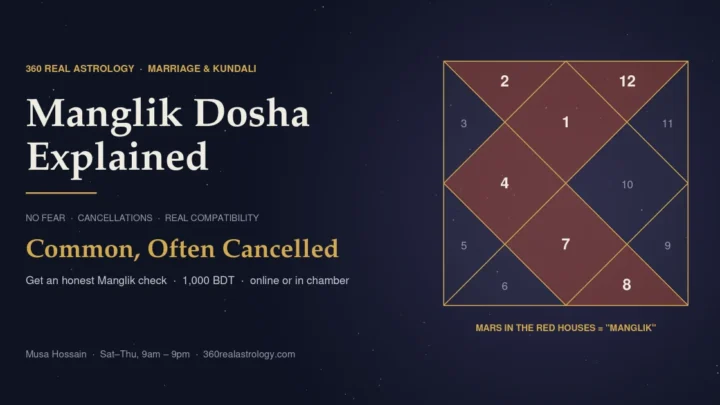
- Mars — placement, aspects, and whether Mangal Dosha is present or cancelled
- The dasha periods either person is running, or about to enter
- The Navamsa chart, which classical practice treats as central to marriage analysis
- Whether the timing itself is favourable for either of them
A couple can score 30 and have a badly afflicted seventh house in both charts. A couple can score 15 with strong seventh lords, a well-placed Venus and Jupiter, and supportive dashas. The second couple is in a better position, and the number says the opposite.
What I actually do
When a family comes to me with a low score, the score is where I start, not where I finish.
I check whether the doshas are cancelled, because often they are and nobody looked. Then I read both charts properly — seventh house, seventh lord, Navamsa, Venus, Jupiter, Mars, and where both people are in their dasha sequence. Then I look at timing, because a difficult period affects a marriage far more reliably than a koota mismatch.
Very often the conclusion is that the score is a technicality and the match is sound. Sometimes the conclusion is that the score is fine but something else in the charts genuinely worries me. Occasionally the two agree.
That is a full Kundali Milan reading, and it costs the same 1,000 BDT as anything else I do, because the fee here does not change with the service.
When I do advise caution
I am not going to pretend astrology never counsels against a match. Sometimes the charts do raise real concerns — a severely afflicted seventh house in both charts, a difficult dasha overlapping the proposed marriage period, patterns that suggest genuine strain.
Even then, what I give you is a description and a timing, not an instruction. The decision is yours and it should be. Nobody should marry or refuse to marry because a chart said so, and any astrologer who claims that authority has taken more than the subject can support.
And one thing worth saying directly: if you have real, non-astrological concerns about a proposed marriage — the person’s behaviour, honesty, how they treat you, pressure you feel from either family — those matter more than any chart. A good score does not make a bad situation safe. Do not let a number talk you out of something you already know.
Common questions
Is 18 out of 36 really the minimum? It is a convention, not a rule from the classical texts. Treat it as the point at which someone should look more carefully.
We scored 15. Is our marriage doomed? No. Check first whether Nadi and Bhakoot dosha are cancelled in your case — together they are 15 of the 36 points, and cancellation is common.
My family will not accept a low score. What do I do? Get a full written analysis rather than a number from a website. A reasoned explanation of why the doshas are cancelled, backed by the classical exceptions, tends to carry weight where “the app said 15” does not.
Does a high score guarantee a good marriage? No. It measures one narrow layer of compatibility from a single data point in each chart.
We do not know one person’s exact birth time. The Moon’s nakshatra changes roughly every day, so guna milan is often workable with an uncertain time. Full chart matching needs rectification first, because the seventh house depends on the ascendant.
Is South Indian matching different? Yes. South Indian practice uses a different koota system and weights the factors differently, which is why the same couple can receive noticeably different scores from two astrologers. Neither is wrong; they are different traditions.
Musa Hossain reads full Kundali Milan — both charts, not just the koota score — from Hosaf Shopping Complex, Malibag Mour, Dhaka-1217. Every day except Thursday, 2:00 pm to 8:00 pm, in English, Bengali or Hindi. One fee for every service: 1,000 BDT. Call 01919-312385 or request an appointment.
Astrology is offered here for guidance and self-enquiry. It is not a substitute for medical, legal or financial advice, and it should not be the sole basis for a decision about marriage.