Almost every week someone arrives at the chamber frightened because another astrologer told them “Shani mahadasha is starting” or “Rahu’s antardasha will destroy everything.” Then they are handed a price list. This guide exists so that you never have to be frightened by those words again. Mahadasha and antardasha are not curses. They are a calendar. Understood properly, they are the most practical tool in Vedic astrology, because they tell you when the promises in your birth chart are most likely to come alive, and what kind of year you are walking into.
Below is the whole system in plain language: where it comes from, how it is calculated, how an honest astrologer reads it, and the superstitions you can safely drop.
The short answer
- Mahadasha (major period) is a long chapter of your life, between 6 and 20 years, “ruled” by one of nine planets. That planet sets the main theme of the chapter.
- Antardasha (sub-period, also called bhukti) is a shorter section inside the mahadasha, from a few months to about three years. Its planet decides which part of the theme is active right now.
- Think of the mahadasha as the season and the antardasha as the weather this month. Your birth chart is the land the weather falls on. The same rain floods one field and feeds another.
Where the dasha system comes from
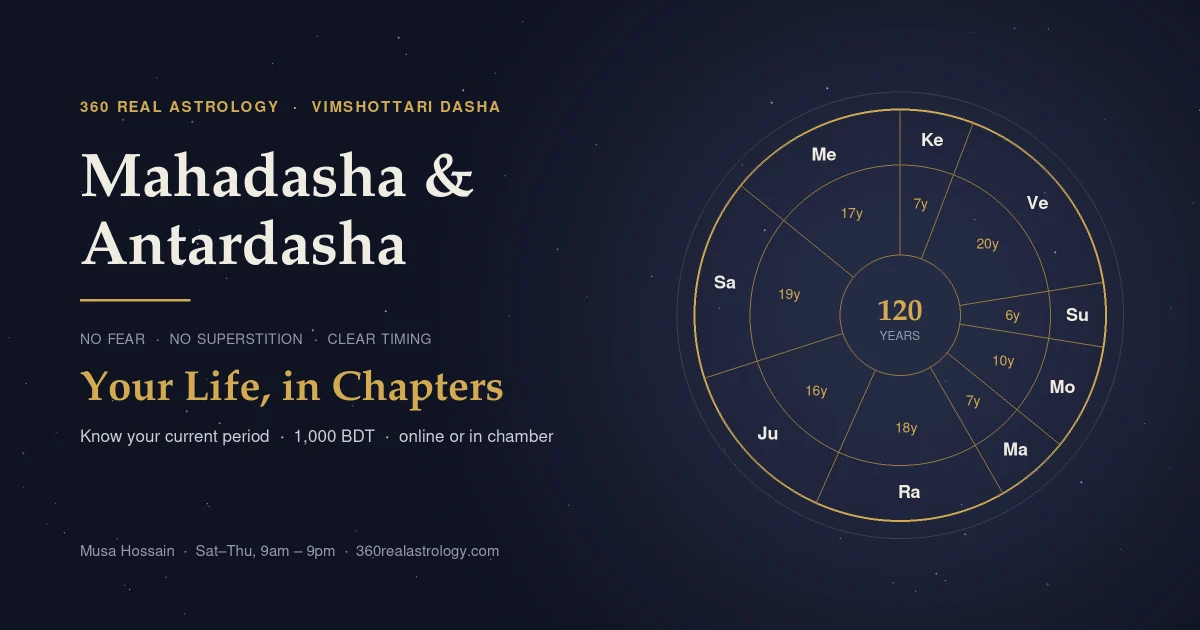
The dasha system most astrologers use is called Vimshottari dasha, described in the classical text Brihat Parashara Hora Shastra. “Vimshottari” means one hundred and twenty, because the nine periods add up to a 120-year cycle.
The order never changes, and each planet always gets the same number of years:
| Planet | Mahadasha length | Nakshatras it rules |
|---|---|---|
| Ketu | 7 years | Ashwini, Magha, Mula |
| Venus (Shukra) | 20 years | Bharani, Purva Phalguni, Purva Ashadha |
| Sun (Surya) | 6 years | Krittika, Uttara Phalguni, Uttara Ashadha |
| Moon (Chandra) | 10 years | Rohini, Hasta, Shravana |
| Mars (Mangal) | 7 years | Mrigashira, Chitra, Dhanishta |
| Rahu | 18 years | Ardra, Swati, Shatabhisha |
| Jupiter (Guru) | 16 years | Punarvasu, Vishakha, Purva Bhadrapada |
| Saturn (Shani) | 19 years | Pushya, Anuradha, Uttara Bhadrapada |
| Mercury (Budh) | 17 years | Ashlesha, Jyeshtha, Revati |
Why your first dasha is decided by the Moon
Your starting mahadasha depends on one thing: the nakshatra (lunar mansion) the Moon occupied at the moment you were born. The planet that rules that nakshatra runs your first mahadasha.
How far the Moon had already travelled through that nakshatra decides how much of the first period was left. If the Moon was born near the start of Rohini (ruled by the Moon), you get almost the full 10-year Moon dasha. If it was near the end, you may get only a year or two before Mars begins.
After that, the sequence simply continues in the fixed order above. That is why nobody lives through all nine mahadashas in one lifetime, and why two people born a few days apart can be in completely different chapters of life.
How antardasha works inside a mahadasha
Every mahadasha is divided into nine antardashas, one for each planet, in the same fixed order. The first antardasha always belongs to the mahadasha planet itself, and then the order continues from there.
The length of each antardasha follows one simple formula:
Antardasha length (years) = Mahadasha years × Antardasha planet’s years ÷ 120
Here is a complete example for a 16-year Jupiter mahadasha:
| Antardasha | Calculation | Approximate length |
|---|---|---|
| Jupiter–Jupiter | 16 × 16 ÷ 120 | 2 years, 1 month, 18 days |
| Jupiter–Saturn | 16 × 19 ÷ 120 | 2 years, 6 months, 12 days |
| Jupiter–Mercury | 16 × 17 ÷ 120 | 2 years, 3 months, 6 days |
| Jupiter–Ketu | 16 × 7 ÷ 120 | 11 months, 6 days |
| Jupiter–Venus | 16 × 20 ÷ 120 | 2 years, 8 months |
| Jupiter–Sun | 16 × 6 ÷ 120 | 9 months, 18 days |
| Jupiter–Moon | 16 × 10 ÷ 120 | 1 year, 4 months |
| Jupiter–Mars | 16 × 7 ÷ 120 | 11 months, 6 days |
| Jupiter–Rahu | 16 × 18 ÷ 120 | 2 years, 4 months, 24 days |
| Total | 16 years | |
The same division repeats one more level down. Each antardasha is split into nine pratyantardashas (sub-sub-periods) of days to months. These are used for fine timing, such as narrowing a good window for a wedding or a job change, but they only mean something once the bigger levels are understood.
How an honest astrologer actually reads your dasha
This is where most confusion, and most fear-selling, begins. A planet’s name alone tells you almost nothing. “Saturn mahadasha” is not good or bad news on its own. What matters is what that planet does in your specific chart. A careful reading checks at least these five things:
1. Which houses the planet rules from your ascendant (lagna). This is the single most important factor. The dasha planet delivers the matters of the houses it owns.
2. Where the planet sits and how strong it is. Its house placement, sign dignity (exalted, own sign, friendly, debilitated), nakshatra, and whether it is combust or retrograde.
3. How the antardasha planet relates to the mahadasha planet. If the two are placed well from each other and are natural allies, the sub-period tends to run smoothly. If one sits in the 6th, 8th or 12th from the other, that sub-period usually asks for more effort and patience. More effort, not disaster.
4. What the divisional charts confirm. A planet that looks weak in the birth chart may be strong in the Navamsa (D9) or Dashamsa (D10). Marriage timing is checked against the D9, career timing against the D10.
5. What the current transits (gochar) are triggering. The dasha shows what is possible in a period. Transits of Saturn and Jupiter often show when within that period it actually happens.
One planet, three completely different stories
Take the most feared period of all, Saturn mahadasha, and look at it from three ascendants:
- Libra (Tula) ascendant: Saturn rules the 4th and 5th houses, which makes it the yogakaraka, the single most beneficial planet for this chart. Its 19-year period is often one of the most productive and stable stretches of life: property, education, children, lasting achievements.
- Taurus (Vrishabha) ascendant: Saturn rules the 9th and 10th houses, fortune and career. Again a yogakaraka. Many people with this ascendant build their career during Saturn’s period.
- Leo (Simha) ascendant: Saturn rules the 6th and 7th houses. Here the period does bring more work around competition, service, partnerships and responsibility, and often needs more patience. That calls for a plan, not panic.
Same planet, same 19 years, three different lives. Anyone who tells you “Saturn dasha is bad” without looking at your ascendant has not read your chart.
What each mahadasha tends to emphasise
The table below shows the themes each planet brings forward. These are areas of life that become louder, not guaranteed events. Whether a theme shows up as growth or as pressure depends on the chart checks above.
| Mahadasha | Themes that tend to become active | What usually helps |
|---|---|---|
| Sun (6 yrs) | Authority, recognition, government matters, father, confidence, leadership | Taking visible responsibility; clear goals |
| Moon (10 yrs) | Home, mother, emotions, public dealings, travel, changes of residence | Routine, rest, emotional honesty |
| Mars (7 yrs) | Energy, courage, property, siblings, technical skills, competition | Channelling drive into disciplined action and exercise |
| Rahu (18 yrs) | Ambition, foreign links, technology, unconventional paths, restlessness | Checking facts before big moves; avoiding shortcuts |
| Jupiter (16 yrs) | Learning, teachers, children, wealth growth, faith, advice-giving | Study, mentorship, generosity with knowledge |
| Saturn (19 yrs) | Work, discipline, responsibility, long-term structures, slow but durable results | Consistency, patience, keeping commitments |
| Mercury (17 yrs) | Business, trade, communication, writing, study, skills, networks | Learning new skills; careful contracts |
| Ketu (7 yrs) | Detachment, research, spirituality, simplifying, letting go of what is finished | Reflection, focus on depth rather than breadth |
| Venus (20 yrs) | Relationships, marriage, comfort, vehicles, arts, beauty, pleasures | Investing in relationships; balance in spending |
Seven superstitions about dasha you can let go of
1. “Saturn, Rahu or Ketu mahadasha will ruin your life.”
No planet is a villain in every chart. As shown above, Saturn is the best planet a Libra or Taurus ascendant can have. Rahu periods have produced some of the biggest career jumps, especially abroad. Ketu periods often bring clarity and focus. The planet’s role in your chart decides the result, not its reputation.
2. “The day the dasha changes, your life changes.”
A new period does not flip a switch at midnight. Effects build gradually over weeks and months. The few months around a mahadasha change (called dasha sandhi, the junction) can feel unsettled, like the end of one school year and the start of another. That is a transition to plan for, not a danger to fear.
3. “A difficult antardasha means death or disaster.”
A challenging sub-period usually means more effort, slower results, or a particular area of life needing attention. Classical astrologers were extremely cautious about predicting death, and so are we. We do not predict death, ever. A reading that leaves you terrified is a sales tactic, not astrology.
4. “Sade Sati and Saturn mahadasha are the same thing.”
They are completely different. Sade Sati is a transit: Saturn moving through the signs around your natal Moon for about seven and a half years. Saturn mahadasha is a dasha period calculated from your birth nakshatra. You can have one without the other. Mixing them up is one of the most common ways people are frightened unnecessarily.
5. “You must do an expensive puja or ritual immediately.”
No genuine reading needs you to pay for an emergency remedy on the spot. Useful remedies for a demanding period are usually practical: discipline, planning, health routines, prayer in your own tradition, charity and service. If a gemstone is suggested, you should be told exactly which planet it strengthens and why. You should also be free to check that reasoning with anyone else.
6. “Wear the gemstone of your dasha lord and everything will improve.”
This one can actually hurt you. If the dasha planet rules difficult houses in your chart, strengthening it with a gemstone can amplify the difficulty. A gemstone is chosen from house lordship and strength, not simply because a planet’s period is running. You can start with our gemstone finder, but the final decision should come from your full chart.
7. “A free online dasha calculator tells you everything.”
Calculators are useful for the dates. They cannot tell you what the period means for you. They are also only as accurate as your birth time. The Moon moves roughly half a degree every hour, so a birth time that is off by an hour can shift your dasha dates by several months. That is why we explain how accurate your birth time needs to be and offer rectification when it is uncertain.
How to use your dasha in real life
The real value of dasha is not prediction. It is planning. Once you know which period you are in and which is coming, you can:
- Time big decisions: marriage, business launch, job change, property purchase or moving abroad, inside the sub-periods that support them.
- Prepare for demanding stretches: save money, protect health, and avoid over-committing before a period that asks for patience.
- Stop blaming yourself: some years are for building, not harvesting. Knowing that removes a great deal of anxiety.
- Make the most of strong periods: a favourable antardasha is a window. Many people waste it simply because they did not know it was open.
What a dasha reading with us includes
In a single session (up to 60 minutes) Musa Hossain will:
- Calculate your current mahadasha, antardasha and pratyantardasha with exact dates.
- Explain what the running period means for your chart: career, marriage, finances, family and health timing.
- Map your next three to five years period by period, marking which windows favour which decisions.
- Tell you honestly which stretches will ask for more effort, with dates and what tends to help.
- Recommend remedies or gemstones only if your chart supports them, with the reasoning explained so you can verify it.
Fee: 1,000 BDT per session, the same for every service. In person at the chamber in Malibag, or online by Google Meet or WhatsApp, in English, Bengali or Hindi. See fees.
What to send: date, time and place of birth, and the one or two questions that matter most to you right now. If you do not know your birth time, tell us. Prashna can answer a pressing question without it.
Want to know which dasha you are in, and what it means for you?
Call 01919-312385, message on WhatsApp, or request an appointment. Same-day slots are often available.
Related: Sade Sati explained: who is in Sade Sati now, with dates by Moon sign (2025–2028).
Common questions
What is the difference between mahadasha and antardasha? The mahadasha is the main planetary period (6 to 20 years) that sets the overall theme. The antardasha is a sub-period inside it (months to about three years) that decides which part of that theme is active now.
How do I find out my current mahadasha? It is calculated from the Moon’s nakshatra and exact degree at your birth. You need your date, time and place of birth. We calculate it for you at the start of every consultation.
Which mahadasha is the best? There is no universally best one. The best period for you is the one whose planet rules good houses in your chart and is well placed and strong. For some people that is Venus, for others Saturn.
Is Rahu mahadasha always bad? No. Rahu amplifies ambition and brings unusual opportunities, often connected to foreign places or technology. When Rahu is well placed, its 18 years can be remarkably successful. It does reward careful checking of facts before big decisions.
Is Saturn mahadasha the same as Sade Sati? No. Sade Sati is Saturn’s transit over your Moon sign. Saturn mahadasha is a dasha period. They are calculated differently and often do not overlap.
What is dasha sandhi? The junction between two mahadashas, usually the last few months of one and the first few of the next. It can feel unsettled because life’s focus is shifting. It is a time to plan, not to fear.
Can remedies change my dasha? No remedy changes which period you are in. Sensible remedies and, above all, sensible decisions can change how well you use it.
How accurate are dasha predictions? Dasha timing is one of the more precise tools in Vedic astrology when the birth time is accurate. It shows tendencies and windows, not fixed events, and a good astrologer will tell you which parts of a reading are firm and which are uncertain.
The short version
Mahadasha is the chapter. Antardasha is the page you are on. Your birth chart decides what is written on it. No planet is your enemy, no period is a sentence, and nobody needs to frighten you to help you.
Used honestly, dasha turns astrology from something you fear into something you can plan with.
Call 01919-312385, message on WhatsApp, or request an appointment.
Musa Hossain: astrologer, palmist and gemologist. Chamber at Hosaf Shopping Complex, Malibag Mour, Dhaka-1217. Every day except Thursday, 2:00 pm to 8:00 pm. In person or online by Google Meet or WhatsApp, in English, Bengali or Hindi. One fee for every service: 1,000 BDT per session, up to 60 minutes.
For guidance and self-enquiry. Not a substitute for medical, legal or financial advice.