Feed a dog. Drop a coin in a river. Keep a square of silver in your pocket. Lal Kitab remedies are famous because they are simple, cheap and do not ask you to buy gemstones or pay for expensive rituals. They are also some of the most copied and misused remedies on the internet. This guide explains what Lal Kitab actually is, how it reads a chart differently from Vedic astrology, the traditional remedy for each planet, the rules that make a remedy safe, and how to know which remedies are really meant for you.
Last updated: October 2026. Written by Musa Hossain, Vedic astrologer and Lal Kitab practitioner, 360 Real Astrology, Dhaka.
The short answer
- Lal Kitab (Bangla: লাল কিতাব, Hindi: लाल किताब, “the red book”) is a system of astrology and palmistry published in five volumes between 1939 and 1952 and attributed to Pandit Roop Chand Joshi (1898–1982) of Punjab.
- It is best known for its upay (remedies): small, practical actions such as feeding animals, donating everyday items, or floating something in flowing water. It does not rely on gemstones or costly rituals.
- Lal Kitab reads the chart with fixed houses: Aries is always the 1st house, Taurus the 2nd, and so on. What matters is which house a planet sits in, not which sign.
- A remedy is only for a planet that is actually weak or troubled in your chart. Doing remedies for planets that are already fine can disturb them. Lal Kitab itself warns about this.
- The traditional rules: do one remedy at a time, in daylight, for 40 to 43 days without a break.
What is Lal Kitab?
Lal Kitab is a collection of astrological teachings written in verse (called farman) in the Urdu language of 1930s to 1950s Punjab. The name means “red book”, after the red cloth binding of traditional account ledgers, an image of the book as a ledger of a person’s life.
The five volumes are:
| Year | Volume |
|---|---|
| 1939 | Lal Kitab ke Farman |
| 1940 | Ilm-e-Samudrik ki Lal Kitab ke Armaan |
| 1941 | Gutka (Ilm-e-Samudrik ki Lal Kitab, third part) |
| 1942 | Lal Kitab ke Farman (revised edition) |
| 1952 | Lal Kitab (the final and largest edition, over 1,100 pages) |
The present texts are credited to Pandit Roop Chand Joshi. Who wrote the original verses is debated, and some traditions say the knowledge is much older. What is clear is that Lal Kitab blends three things: classical astrology, Samudrik Shastra (palmistry and body reading), and practical folk wisdom from Punjab. It is popular across India and Pakistan, and many people in Bangladesh search for Lal Kitab remedies today.
Lal Kitab vs Vedic astrology: the key differences
| Vedic (Parashari) astrology | Lal Kitab | |
|---|---|---|
| Houses | Start from your rising sign (Lagna); signs move from chart to chart | Fixed: Aries is always house 1, Pisces always house 12 |
| Main focus | Signs, houses, aspects, divisional charts, yogas | Planet-in-house placement and planets’ relationships |
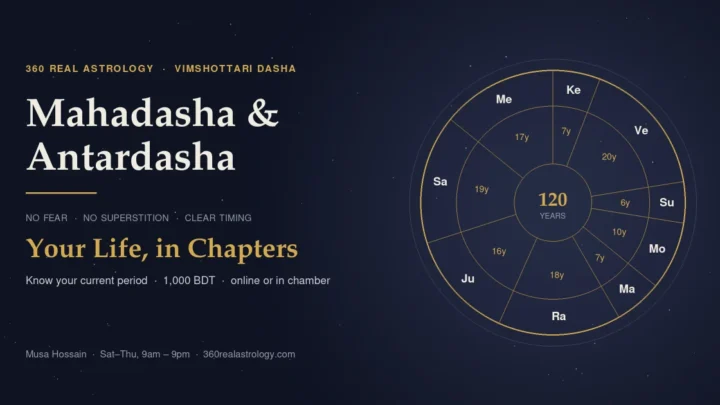
| Timing | Vimshottari dasha (120 years), transits | Age-based planetary periods and Varshphal (yearly chart from a fixed table) |
| Remedies | Gemstones, mantras, rituals, charity | Simple everyday actions; no gemstones required |
| Palmistry | Separate subject | Built in: palm lines are used to confirm or correct the chart |
| Key ideas | Yogas, doshas, dasha lords | Pakka ghar (permanent house), sleeping planets, rin (karmic debts), enemy planets |
Lal Kitab is not a replacement for Vedic astrology. In practice they work best together: the Vedic chart and dashas show what is happening and when; Lal Kitab offers simple ways to respond.
Core Lal Kitab concepts in plain language
- Fixed house chart. Your planets keep the house numbers they have in your birth chart, but the houses are read as fixed signs (house 1 = Aries, house 2 = Taurus and so on). The house tells you the area of life a planet affects.
- Pakka ghar (permanent house). Each planet has a house where it is naturally “at home”: for example the Sun in the 1st, Jupiter in the 2nd, Mars in the 3rd and 8th, the Moon in the 4th, Venus and Mercury in the 7th, Saturn in the 8th, Ketu in the 6th and Rahu in the 12th. A planet in its pakka ghar is usually steady.
- Exalted, debilitated and troubled planets. Some houses strengthen a planet and others weaken it. A weakened planet is the one that may need a remedy.
- Enemy planets. Lal Kitab lists natural enmities (for example Saturn with the Sun and Moon). Enemies sharing a house can create friction in that area of life.
- Sleeping planets and houses. A planet or house that is not activated by any other planet is said to be “asleep”. It gives fewer results until it is awakened, sometimes by a remedy, sometimes by time.
- Rin (karmic debts). Certain patterns are read as debts carried from family or past actions, such as Pitri Rin (ancestral debt). Lal Kitab treats them as responsibilities to be repaid through service, not as curses.
Traditional Lal Kitab remedies for each planet
These are the remedies most often associated with each planet in Lal Kitab tradition. They are a general guide, not a prescription. The right remedy depends on the house the planet sits in and why it is weak. The same planet in two different houses can need opposite remedies.
| Planet | Rules over | Commonly cited remedies |
|---|---|---|
| Sun (Surya) | Father, authority, government, confidence | Offer water to the rising Sun; respect and serve your father; keep your word; donate wheat or jaggery |
| Moon (Chandra) | Mother, mind, peace, emotions | Respect and serve your mother; take her blessings; keep a silver item; donate milk or rice |
| Mars (Mangal) | Siblings, courage, property, anger | Help your brothers; donate red lentils (masoor) or sweets; control anger; keep a clean, unbroken home |
| Mercury (Budh) | Speech, business, study, sisters and aunts | Feed green fodder to animals; respect sisters, daughters and aunts; keep promises in business; donate green moong |
| Jupiter (Guru) | Teachers, wisdom, children, fortune | Respect teachers and elders; apply a turmeric or saffron mark; donate to places of learning or worship; avoid lying |
| Venus (Shukra) | Marriage, spouse, comfort, beauty | Respect your spouse; feed cows; donate curd, ghee or clean clothes; keep yourself and your home clean |
| Saturn (Shani) | Work, servants, workers, discipline, delay | Help labourers and the poor; donate mustard oil or black items; feed crows; avoid alcohol and dishonesty |
| Rahu | Sudden events, confusion, foreign matters | Keep a piece of solid silver; float barley or coal in flowing water; avoid intoxicants; keep the home’s threshold clean |
| Ketu | Children, sons, spiritual life, detachment | Feed a dog; donate a blanket; respect your maternal uncles; support children in need |
Notice the pattern: most Lal Kitab remedies are about relationships, honesty, service and habits. That is why many people find them helpful whether or not they think of them in astrological terms.
The rules for doing Lal Kitab remedies safely
- Only for planets that need it. Remedies are for weak or troubled planets in your own chart. Remedying a strong planet can weaken it.
- One remedy at a time. Doing many remedies together makes it impossible to know what is working and can create new imbalances.
- 40 to 43 days. Continue the chosen remedy daily for 40 to 43 days. If you miss a day, start counting again.
- In daylight. Traditionally remedies are done between sunrise and sunset.
- A blood relative can help. If you cannot do a remedy yourself (for example while travelling), a close blood relative may do it on your behalf.
- No harm, no waste. Never follow a “remedy” that harms a person or animal, wastes food in a hurtful way, or pollutes. Floating items in water means small, natural items, not plastic.
- Not a substitute for real-world help. Remedies support your effort. They do not replace a doctor, a lawyer, a financial adviser or hard work.
Six myths about Lal Kitab
- “Lal Kitab is black magic.” No. It is a book of astrology and palmistry. Its remedies are ordinary acts of charity, respect and discipline.
- “The remedies work for everyone.” A remedy is chosen for a specific planet in a specific house. A remedy copied from the internet can be the wrong one for your chart.
- “More remedies, faster results.” The opposite. Lal Kitab says one remedy at a time, done properly, for 40 to 43 days.
- “Lal Kitab totke give instant results.” Anyone promising instant love, wealth or a “guaranteed” result in days is selling fear or hope, not Lal Kitab.
- “You need an expensive puja or a special amulet.” Lal Kitab remedies are deliberately cheap and done by you. Nobody needs to sell you anything.
- “Lal Kitab replaces your kundli.” It works with your birth chart, not instead of it. A proper reading uses your exact birth time and the full chart.
How to find the right Lal Kitab remedy for you
To choose a remedy properly, an astrologer needs to:
- Cast your chart accurately from your date, time and place of birth (see how accurate your birth time needs to be).
- Convert it into the Lal Kitab fixed-house chart.
- Check each planet: pakka ghar, exalted or debilitated house, enemies sharing the house, and whether it is asleep.
- Pick remedies only for the planets that genuinely need help, matched to the house they sit in.
- Cross-check with your Vedic chart and current dasha, because the planet whose period you are running matters most right now (see Mahadasha and Antardasha explained).
Lal Kitab at 360 Real Astrology
Every consultation with Musa Hossain includes a written birth chart report with a dedicated Lal Kitab section: your Lal Kitab chart, a status for each planet (well placed, normal, or needs remedy), house-specific remedies only for the planets that need them, a do’s and don’ts list, and the rules for doing them. In the session, every remedy is explained from your chart, in English, Bengali or Hindi. There is no fear-selling and nothing you are required to buy. Read more about how we work.
Fee: 1,000 BDT per session, up to 60 minutes, in person in Dhaka or online worldwide. Book your consultation here.
Common questions
What is Lal Kitab? Lal Kitab (“red book”) is a system of astrology and palmistry published in five volumes between 1939 and 1952, credited to Pandit Roop Chand Joshi of Punjab. It is known for simple, low-cost remedies called upay.
Who wrote Lal Kitab? The published volumes are credited to Pandit Roop Chand Joshi (1898–1982) of Pharwala village, Jalandhar district, Punjab. The origin of the original verses is debated.
How is Lal Kitab different from Vedic astrology? Lal Kitab uses a fixed-house chart in which Aries is always the 1st house, focuses on which house each planet occupies, uses its own yearly chart (Varshphal), includes palmistry, and prescribes simple remedies instead of gemstones and rituals.
Do Lal Kitab remedies really work? Results depend on choosing the right remedy for a genuinely weak planet and doing it consistently. Many remedies build healthier habits, better relationships and regular charity, which help in their own right. No remedy is guaranteed, and none replaces practical action or professional advice.
How long should a Lal Kitab remedy be done? Traditionally for 40 to 43 days in a row, in daylight, one remedy at a time. If a day is missed, the count starts again.
Can I do Lal Kitab remedies without seeing my chart? It is not recommended. A remedy that helps a weak planet can harm the same planet when it is strong or placed in a different house. Check your chart first.
Can someone else do a Lal Kitab remedy for me? Traditionally a close blood relative may perform a remedy on your behalf if you cannot.
Does Lal Kitab use gemstones? Lal Kitab’s own remedies do not depend on gemstones. Some practitioners combine Lal Kitab with gemstone advice from Vedic astrology, which should only be given after a full chart check (see gemstone remedies by planet).
What is a sleeping planet in Lal Kitab? A planet that is not activated by other planets is called “sleeping”. It tends to give weaker or delayed results until it is awakened by time, by a related planet or by a suitable remedy.
What is Pitri Rin in Lal Kitab? Pitri Rin means ancestral debt: a chart pattern read as a family responsibility. Lal Kitab suggests repaying it through shared family charity and service, not through fear or expensive rituals.
Is Lal Kitab connected with any religion? Lal Kitab is an astrological text, not a religious scripture. Its remedies are mostly everyday acts of respect, charity and discipline, which people of any background can follow.
Where can I get a Lal Kitab reading in Dhaka? Musa Hossain at 360 Real Astrology offers Lal Kitab analysis as part of every consultation, in person at Malibag, Dhaka, or online worldwide, for 1,000 BDT per session.
The short version
Lal Kitab is a practical branch of astrology: a fixed-house chart, a sharp focus on which house each planet sits in, and remedies that are simple, cheap and done by you. Used well, it turns astrology into small, steady actions. Used carelessly, copied remedies can work against you. Check your chart first, do one remedy at a time for 40 to 43 days, and stay away from anyone selling fear.
Call 01919-312385, message on WhatsApp, or book a consultation online.
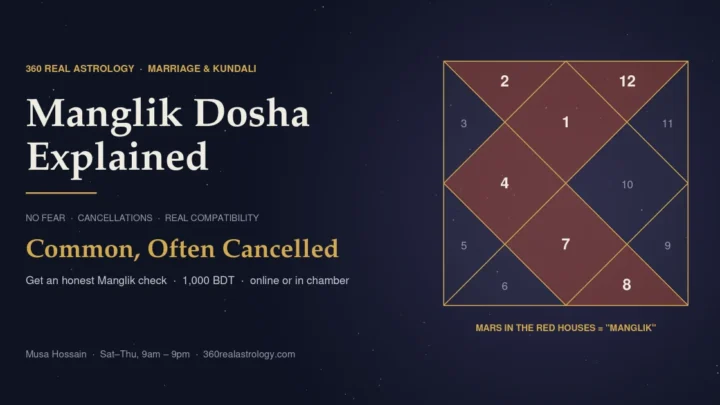
Related reading: Sade Sati explained · Manglik dosha explained · Remedies for Rahu and Ketu · Remedies for weak planets
Written by Musa Hossain: Vedic astrologer, palmist and gemologist at 360 Real Astrology, Dhaka. Chamber at Hosaf Shopping Complex, Malibag Mour, Dhaka-1217. Consultations every day except Thursday, 2:00 pm to 8:00 pm, in person or online, in English, Bengali or Hindi. One fee for every service: 1,000 BDT per session, up to 60 minutes.
For guidance and self-enquiry. Not a substitute for medical, legal or financial advice.