
How to Calculate Astrological Houses in Your Birth Chart

Your birth chart is a unique snapshot of the sky at the moment you were born. It is divided into twelve distinct sectors called houses. Each of these zones represents a different area of your life, from relationships and career to personal dreams.
To map these houses correctly, you need your exact birth time, date, and location. This information pinpoints the Ascendant, which is the starting point for the entire zodiac wheel. The Ascendant sets the first house cusp, and the rest follow from there.
Different traditions in the study of the stars use various systems to draw these divisions. The choice of system can slightly shift where the house lines fall. This influences how you interpret the planets within each life domain.
This guide will walk you through the essential steps. You will learn how to determine your astrological houses and understand their profound meaning. We aim to empower you to read your own natal chart with clarity and confidence.
Key Takeaways
- The twelve houses form the framework of your birth chart, each governing specific life experiences.
- Accurate birth data (time, date, place) is absolutely essential for correct house placement.
- Different house systems exist, and your choice can affect the chart’s interpretation.
- Planetary positions within houses reveal how celestial energies manifest in your life.
- Mastering house calculation is a fundamental skill for accurate chart analysis.
- This guide provides the foundational knowledge for both beginners and seasoned practitioners.
Introduction to Astrological Houses
Think of your birth chart as a personal map. The houses are the distinct territories that make up your world. In astrology, these twelve sections form the core framework of your natal chart.
Each one governs specific areas of your life. They range from your sense of self to your deepest spiritual connections.
What Are Astrological Houses?
The system begins at your Ascendant. This point sets the cusp of your first house. The other eleven zones follow in order around the wheel.
To understand their function, it helps to see how they relate to planets and signs. The table below breaks it down.
| Celestial Component | Represents | Example |
|---|---|---|
| Planets | The “What” – Core energies & drives | Venus symbolizes love and harmony. |
| Zodiac Signs | The “How” – Style & manner of expression | Taurus gives Venus a steady, sensual style. |
| Houses | The “Where” – Area of life where it happens | The 7th house places that energy in partnerships. |
The Role of Houses in Chart Interpretation
Houses provide essential context. They tell you where a planet’s energy will manifest most strongly.
For instance, Venus in the 7th house emphasizes harmony in close relationships. The same planet in the 10th house points to a love of public recognition.
This transforms generic planetary interpretations into personalized insights. It reveals the specific areas where you’ll experience growth and challenges.
Understanding House Systems and Their Role in Natal Charts
The division of your chart into twelve life areas is not universal. It depends on the house system used. These mathematical frameworks define where each sector begins and ends.
Your choice of a house system acts as the skeleton for your natal chart. It anchors planetary movements to specific contexts.
Overview of Different House Systems
More than a dozen house systems exist in practice. Each uses a unique method to slice the celestial wheel.
Some, like Placidus, create unequal sectors based on time. Others, like Whole Sign, assign one complete zodiac sign per house.
| House System | Primary Method | Key Characteristic |
|---|---|---|
| Placidus | Time-based division | Houses vary in size; most common in Western astrology. |
| Whole Sign | Sign-based division | Each house aligns with one complete zodiac sign. |
| Equal House | Equal 30-degree sectors | Simple and consistent house sizes. |
| Koch | Birth place-centric | Emphasizes geographical location in calculations. |
Impact on Life Areas and Planetary Positions
The selected house system can change your chart’s interpretation. A planet near a cusp may shift into a different sector.
This moves the planetary energy from one life domain to another. For example, a planet could jump from career themes to home life.
Understanding these differences is key for personalized insights. Experimenting with various systems can reveal which one resonates with your experience.
How to Calculate Astrology Houses for Your Natal Chart
Gathering your exact birth data is the first, non-negotiable step in chart construction. You need your precise time, date, and location. Even a few minutes can shift your house cusps.
Essential Tools and Software
Modern software and online calculators do the heavy lifting. They replace the old manual methods used by every professional astrologer. A good tool will generate two key tables.
The first shows your planets and points in each house across different systems. The second lists the exact degrees of your house cusps and what sign they are in.
Step-by-Step Calculation Process
Follow this simple sequence for accuracy:
- Gather Data: Use your official birth certificate for the best time.
- Input Information: Enter details into reliable software, ensuring the correct UTC offset.
- Select System: Choose one house system or compare several.
- Review Output: Examine your generated chart and note planetary placements.
This process gives you a clear, personalized map of your natal chart.
Exploring Popular House Systems for Chart Interpretation
Astrological house systems offer distinct lenses through which to view your natal chart. Your choice shapes how planetary energies are assigned to life areas.
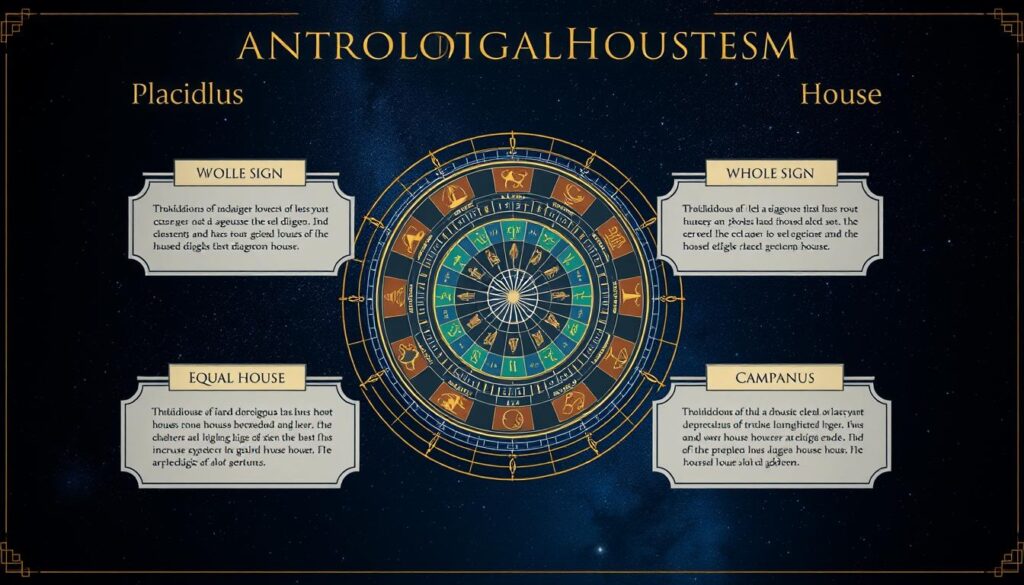
Placidus House System: History and Mechanics
Developed in the 17th century, the Placidus house system is the Western standard. It uses a time-based method tied to the Earth’s rotation.
This creates sectors of varying size based on daylight length. It provides detailed timing insights but struggles near the poles.
Whole Sign and Equal House Systems Explained
The whole sign approach is ancient, dating back thousands of years. Here, each complete zodiac sign becomes one sign house.
It offers great clarity for life themes. The equal house system is different. It makes twelve identical 30-degree sectors from the Ascendant.
This creates a balanced, simple structure. Many find it psychologically harmonious.
Topocentric and Other Modern Systems
The Topocentric system is a modern refinement. It adds precise geographic adjustments for accuracy.
Other systems like Koch and Campanus offer unique mathematical angles. Exploring them can deepen your chart analysis.
| House System | Primary Method | Best For | Consideration |
|---|---|---|---|
| Placidus | Time-based division | Predictive work & detailed timing | May distort at high latitudes |
| Whole Sign | One sign per house | Beginners & thematic clarity | Less precise for timing events |
| Equal House | Equal 30-degree sectors | Psychological balance & simplicity | Ignores celestial irregularities |
| Topocentric | Geographic precision | Chart rectification & exact data | Requires very accurate birth info |
Practical Tips for Achieving Accurate Calculations
To ensure your house cusps are correct, you must sidestep typical pitfalls. The quality of your natal chart’s insights depends entirely on the precision of your foundational data.
Common Pitfalls and How to Avoid Them
The most frequent error is an incorrect birth time. Even a four-minute mistake can shift a cusp by a full degree. This might change your Ascendant sign. Always use your official birth certificate for verification.
Time zone confusion is another major issue. Historical daylight saving changes or region shifts can affect the UTC offset. Double-check this detail in your software.
Geographic imprecision also hurts accuracy. Using a general city name instead of exact coordinates can misplace your house lines. Get the most specific latitude and longitude possible.
Planets located near house cusps require special attention. Their energy may blend two life areas. Your interpretations should reflect this nuance.
Many professionals work with multiple house systems. This offers a richer perspective than sticking to just one. The right system is the one that resonates with your lived experience.
| Common Pitfall | Why It Matters | Best Practice |
|---|---|---|
| Inaccurate Birth Time | Shifts house cusps and can alter the Ascendant sign. | Verify time against an official birth certificate. |
| Time Zone Confusion | Leads to an incorrect sidereal time calculation. | Research historical time data for your birth location. |
| Using Only One System | Limits your interpretive perspective. | Compare results from Placidus, Whole Sign, and Equal house systems. |
| Vague Location Data | Introduces errors in house cusp placement. | Use precise geographic coordinates, not just a city name. |
If your birth time is uncertain, consult an experienced astrologer for rectification work. For all your chart work, use reputable software with reliable databases. This commitment to accuracy makes your personal astrology truly meaningful.
Tools and Best Practices for Your Astrology Journey
Modern software transforms complex astrological calculations into accessible insights. The right tools and methods elevate your practice from basic data to profound understanding.

Enhancing Accuracy with Modern Software
Professional programs offer instant access to many house systems. You can compare your birth chart across different frameworks with one click.
This software uses reliable astronomical databases. It ensures precision in timing and location data far beyond manual work.
Look for features that provide clear visualizations of house cusps. Customization options for various systems are key for deep analysis.
Interpreting Your Results for Better Insights
Effective chart interpretation integrates multiple layers. House placement is just one part of the story.
Always combine it with zodiac sign positions and planetary aspects. This creates a complete picture of your life areas.
Set clear goals for each reading session. Are you exploring themes, seeking psychological insight, or focusing on timing?
Planets in angular houses (1st, 4th, 7th, 10th) are especially significant. They represent powerful points connected to your personal horizon.
| House System | Best Use Case | Key Strength |
|---|---|---|
| Placidus | Predictive work & detailed timing | Time-based precision for event analysis |
| Whole Sign | Thematic clarity & traditional study | Simple, sign-based structure for life patterns |
| Equal House | Psychological balance & beginner practice | Consistent 30-degree sectors for harmony |
| Topocentric | Chart rectification & geographic accuracy | Advanced adjustments for exact birth data |
Your personal experience is the ultimate guide. Experiment with different systems to see which interpretations resonate most strongly with your world.
Conclusion
Mastering the division of your natal chart opens a door to profound self-discovery. It moves you beyond generic readings into personalized insights about your unique life path, career, and relationships.
The house systems you select form the foundational framework for this work. Whether you use Placidus, Whole Sign, or another system, they divide the zodiac into twelve houses. Your journey with them is truly personal.
Experiment to see which framework best mirrors your lived experience and the placement of planetary signs. This knowledge provides a solid foundation for all your astrological practice.
The perspective you gain elevates your entire approach to reading a chart. It reveals where cosmic energies actively shape your world, guiding you toward greater self-awareness.
FAQ
What exactly are the houses in a natal chart?
In a birth chart, the houses are twelve sections that divide the sky’s rotation at your time and place of birth. Each segment corresponds to a specific area of your life, such as relationships, career, or personal goals. Planets located in these sections color how you experience those life domains.
Why are there different house systems, and does it matter which one I use?
Different systems, like Placidus or Whole Sign, use unique mathematical methods to draw those twelve sections. The choice can shift which planets fall into which life areas, offering a new perspective. Many practitioners find one method resonates more for their practice, so experimenting is key.
What do I need to figure out my own house placements?
You need your precise birth date, location, and time. With that data, reliable software like Solar Fire or websites such as Astro.com can do the complex math instantly. These tools generate your natal chart, clearly showing the house cusps and planetary positions.
Why is the Placidus method so common in Western practice?
The Placidus house system has been the standard for many years, especially in psychological interpretations. Its widespread use in software and textbooks makes it a default. Its time-based approach to dividing the sky often aligns with an individual’s personal experience of life’s rhythms.
What’s a frequent mistake people make when interpreting houses?
A common pitfall is focusing only on the zodiac sign on a house cusp. The planets inside a section and their aspects hold greater weight for chart interpretation. Ignoring this can lead to an incomplete view of how those life areas actually manifest.
Can modern software improve the accuracy of my chart analysis?
Absolutely. Programs like Kepler or Win*Star handle complex calculations for any location or era, removing human error. This lets you focus on synthesis and interpretation, leading to deeper and more consistent insights from your natal chart.
About Me:

Musa Hossain, A Modern Astrologer, Palmist, Occultist Scientist and Gemologist
Our Astrological Gemstone
-
 Natural Red Coral
Price range: $225.00 through $400.00
Natural Red Coral
Price range: $225.00 through $400.00
-
 Natural Blue Sapphire
Price range: $1,500.00 through $3,000.00
Natural Blue Sapphire
Price range: $1,500.00 through $3,000.00
-
 Natural Sea Pearl
$400.00
Natural Sea Pearl
$400.00
-
 Natural Yellow Sapphire
Price range: $350.00 through $650.00
Natural Yellow Sapphire
Price range: $350.00 through $650.00
-
 Natural Emerald Gemstone
Price range: $300.00 through $550.00
Natural Emerald Gemstone
Price range: $300.00 through $550.00

Connect me