Introduction: Growth Has a Rhythm
Modern life often rewards speed. Answer immediately. Improve everything at once. Turn a weekend into a five-year transformation plan. Then wonder why motivation quietly leaves through the nearest window.
Ancient Egypt offers a more sustainable idea: growth happens in cycles.
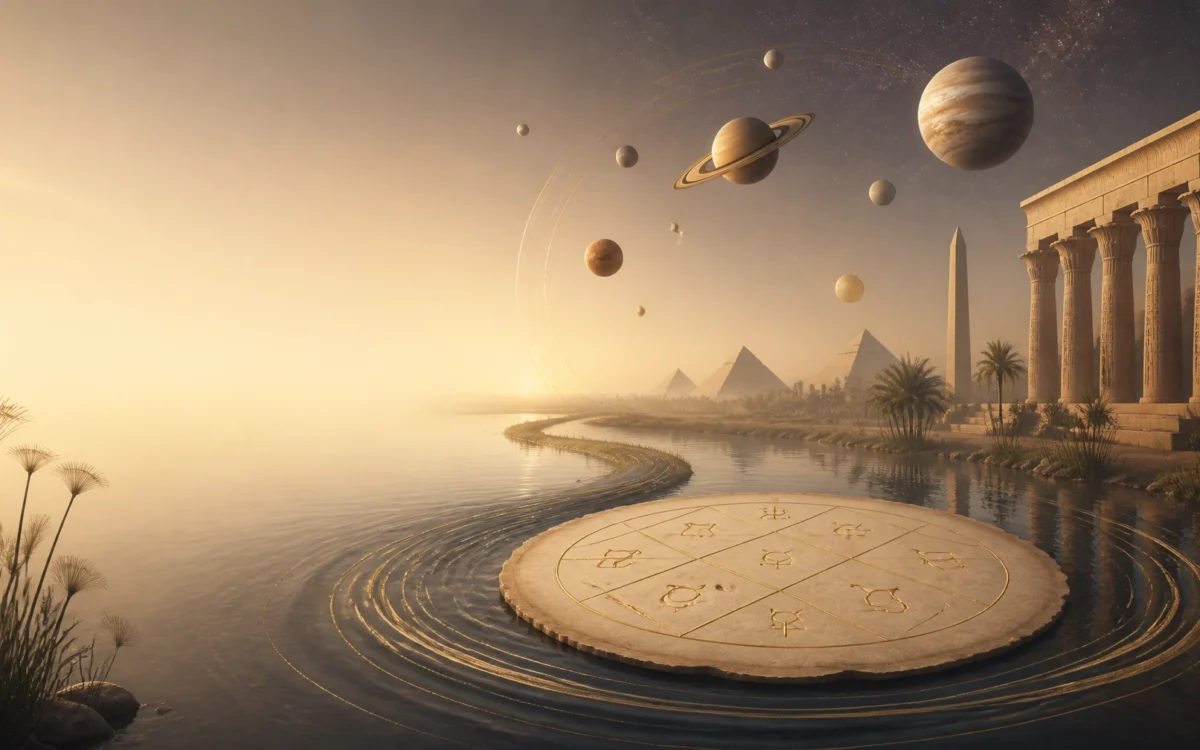
The Nile did not nourish the land through one dramatic event. Its annual rhythm moved through flooding, planting, cultivation, and harvest. Each phase had a purpose. Waiting was not wasted time, and preparation was not separate from progress.
Your life also has seasons. Some periods are for learning, others for building, resting, simplifying, or gathering results. Vedic astrology can help you recognize these patterns through your natal chart, planetary cycles, dashas, and transits.
Astrology offers patterns and timing. Your daily choices create outcomes.
When you understand both, you can stop forcing every season to produce the same result and begin co-creating your reality with greater patience, awareness, and consistency.
The Nile’s Seasonal Cycle: A Lesson in Sustainable Growth
Ancient Egyptian agriculture was organized around three broad seasons:
- Akhet, the inundation or flooding period
- Peret, when the waters receded and crops emerged
- Shemu, the harvest season
The annual flood brought water and nutrient-rich silt to the fields. Farmers then worked with the land’s condition rather than demanding that it behave like a field in another season.
This did not mean Egyptians simply waited for nature to do everything. They maintained embankments, managed basins, observed water levels, planted at suitable times, and planned for harvest. Sustainable growth required cooperation between natural timing and human effort.
Egyptian officials used instruments known as nilometers to monitor the river’s level. These measurements helped communities understand whether the coming agricultural season might be abundant, difficult, or somewhere in between. The nilometer was not a magic machine that guaranteed a harvest. It was a practical tool for observation and preparation.
You can explore a historical overview of Nile flooding through Britannica’s account of the Nile’s climate and hydrology and research on the ancient nilometer through Archaeology Magazine.
The lesson is beautifully simple: measure the conditions, respect the season, and act accordingly.

What Happens When We Ignore Our Personal Seasons?
Many people approach personal growth as a constant demand for output. They expect themselves to work at maximum intensity in relationships, career, health, finances, and spirituality all at once.
This creates three familiar problems.
1. Overplanting
A farmer cannot plant every crop in every field at the same time. Similarly, trying to create ten major habits at once usually leads to scattered attention.
You may begin a new exercise plan, business idea, meditation routine, course, savings strategy, and relationship reset in the same week. By the following month, the plan has become a museum exhibit.
2. Harvesting too early
Some goals require preparation before visible results appear. Learning a skill, rebuilding trust, improving health, and developing financial stability all need repeated effort.
If you judge the process too soon, you may abandon useful work simply because it has not matured yet.
3. Refusing to rest between cycles
Rest is not the opposite of discipline. It is part of sustainable discipline. The Nile’s cycle included periods when the land was submerged, replenished, and prepared before planting began again.
A person who never pauses may confuse exhaustion with progress.
Astrological Meaning: Your Chart as a Personal Agricultural Map
In modern Vedic astrology, the natal chart can be viewed as a map of tendencies, resources, challenges, and timing. It does not remove responsibility or dictate a single unavoidable future.
A chart may show that you naturally build slowly, respond strongly to changing circumstances, thrive through study, or need structure before confidence develops. Planetary periods and transits can then highlight when certain themes become more noticeable.
Vimshottari dasha, for example, divides life into planetary periods. A major period may describe a broad chapter, while a sub-period can bring a more focused area of experience. Transits add another layer by showing current planetary movement in relation to the natal chart.
These cycles are best used as planning tools, not as excuses.
- A Saturn-influenced period may be useful for structure, responsibility, and long-term foundations.
- A Jupiter-influenced period may encourage education, teaching, ethical expansion, or mentorship.
- A Mercury-influenced period may support writing, communication, business systems, and skill development.
- A Mars-influenced period may be suitable for decisive action, physical training, and courageous beginnings.
- A Venus-influenced period may draw attention to values, creativity, relationships, and financial choices.
- A Sun-influenced period may invite leadership, visibility, and clearer personal direction.
The same planet can express differently for different people. Its house placement, sign, strength, relationships with other planets, and role in the individual chart all matter.
This is why a generic horoscope cannot replace a personal reading. A seasonal principle is helpful; a precise map is better.
One Carefully Considered Gemstone: Blue Sapphire
In Vedic gemstone tradition, Blue Sapphire is associated with Saturn. When Saturn is supportive in an individual chart, a properly selected stone may be considered as a symbolic aid for qualities such as discipline, patience, responsibility, and sustained effort.
That does not mean the stone creates success by itself. Its potential role is supportive, while your habits, decisions, and circumstances remain central.
Traditional wearing method
If an expert determines that Blue Sapphire is suitable, the customary method may include:
- A natural, treatment-verified stone
- Set in silver or another astrologically appropriate metal
- Worn on the middle finger
- Traditionally begun on a Saturday, at a suitable time selected after consultation
These are traditional guidelines, not universal rules.
Blue Sapphire should never be self-prescribed based on a social media post, a birth month, or a general zodiac sign. It may not be suitable for every chart. Recommendations must be based on an individual birth chart consultation, with the stone’s quality and treatment status checked carefully.
If Blue Sapphire is not appropriate, practical Saturn-oriented habits: such as keeping a realistic schedule, honoring commitments, reducing clutter, and completing one long-term task consistently: may be more useful than wearing any stone.
Practical Advice: Build Your Own Akhet–Peret–Shemu Routine
You can apply the Nile’s rhythm to a personal goal in four steps.
Step 1: Identify your current season
Ask yourself:
- Am I recovering and gathering information?
- Am I ready to begin consistent action?
- Am I maintaining progress?
- Am I reviewing results and deciding what to continue?
Do not label a quiet season as failure. It may be preparation.
Step 2: Choose one primary field
Select one major area for the next 8–12 weeks:
- Career development
- Physical wellbeing
- Financial organization
- Relationship communication
- Education or skill-building
- Spiritual and emotional balance
You can care about everything without trying to transform everything simultaneously.
Step 3: Create a small repeatable habit
Make your action measurable:
- Read for 20 minutes, five days a week
- Walk for 30 minutes, four days a week
- Review finances every Sunday
- Spend 15 minutes planning the next workday
- Have one honest relationship conversation each week
Small habits may look unimpressive at first. Crops also tend to be less dramatic before they become visible.
Step 4: Review before expanding
At the end of each month, ask:
- What produced real improvement?
- What consumed energy without helping?
- What needs more time?
- What should be simplified?
- What is ready for the next stage?
This approach keeps astrology grounded. Your chart may suggest timing, but your calendar reveals whether you are actually participating.

How 360 Real Astrology Helps You Co-Create Your Life
At 360 Real Astrology, we treat a chart as a map, not a verdict.
Our approach combines classical Vedic astrology, including the Parashari method and Vimshottari dasha, with modern counselling, practical decision frameworks, and careful gemstone assessment. The goal is not to overwhelm you with technical language or dramatic predictions. It is to connect astrological patterns with decisions you can realistically make.
A consultation may help you:
- Understand the main themes of your natal chart
- Identify productive periods for action, study, or consolidation
- Translate planetary symbolism into practical routines
- Recognize when impatience is creating unnecessary pressure
- Consider a gemstone only when the chart genuinely supports it
- Build a personal growth plan with clear priorities
Our philosophy respects both ancient wisdom and modern reasoning. Egyptian seasonal thought and Vedic astrology come from distinct traditions, so we do not pretend they are the same system. Instead, we use the Nile’s cycle as a powerful reflective framework alongside astrological timing.
To explore our approach, visit the 360 Real Astrology About page or book an expert consultation.
If a gemstone is appropriate after your reading, you can also ask about purchasing an authentic, treatment-verified stone or a NavaRatna ring. Suitability should always be checked first: especially before choosing a ring containing multiple planetary stones.
Frequently Asked Questions
1. What does the Nile’s cycle teach us about personal growth?
It teaches that growth has phases. Preparation, action, maintenance, harvest, and recovery all contribute to sustainable progress.
2. Can a natal chart tell me exactly when I will succeed?
No. A natal chart and timing techniques can suggest patterns, themes, and potentially supportive periods. They cannot guarantee a particular outcome. Your choices and circumstances remain important.
3. How does Vedic astrology support habit-building?
Vedic astrology can help identify planetary themes in a current period. Those themes may suggest whether to emphasize structure, learning, communication, leadership, rest, or disciplined action.
4. Should I start several new habits during a favorable planetary period?
Usually, focusing on one or two well-defined habits is more sustainable than starting everything at once. A favorable period still benefits from realistic planning.
5. Is Blue Sapphire suitable for everyone?
No. Blue Sapphire should only be considered after an individual birth chart consultation and proper gemstone verification. Traditional suitability depends on the complete chart, not just a zodiac sign.
6. Is a NavaRatna ring automatically beneficial?
No. A NavaRatna ring contains multiple planetary stones and may not suit every individual. Ask an experienced astrologer to assess your chart before purchasing or wearing one.
7. Can astrology replace professional medical, financial, or legal advice?
No. Astrology may support reflection and planning, but it should not replace qualified medical, financial, psychological, or legal guidance.
Conclusion: Let Your Growth Become Sustainable
The Nile’s rhythm reminds us that lasting growth is rarely a straight line. There are times to absorb, times to plant, times to work steadily, and times to gather what the season has produced.
Your natal chart can help you reflect on your personal timing and tendencies. Vedic astrology may offer useful patterns through planetary periods and transits. But astrology does not make the daily choice for you.
You co-create your reality through observation, preparation, action, review, and repetition.
If you are ready to understand your current life season, book a birth chart reading with 360 Real Astrology. For gemstone guidance, speak with an expert before purchasing an authentic gemstone or NavaRatna ring. The right remedy begins with the right understanding.
Meta description: Discover how the Nile’s seasonal rhythm and Vedic astrology can guide sustainable habits, personal timing, long-term growth, and conscious life choices.